
HVAC
Wafer Type
Compact wafer bodies clamped between companion flanges for HVAC, fire protection, and light isolation.
F07–F14Quarter-turn
Wafer type Butterfly Valve · ISO 5211 / AWWA
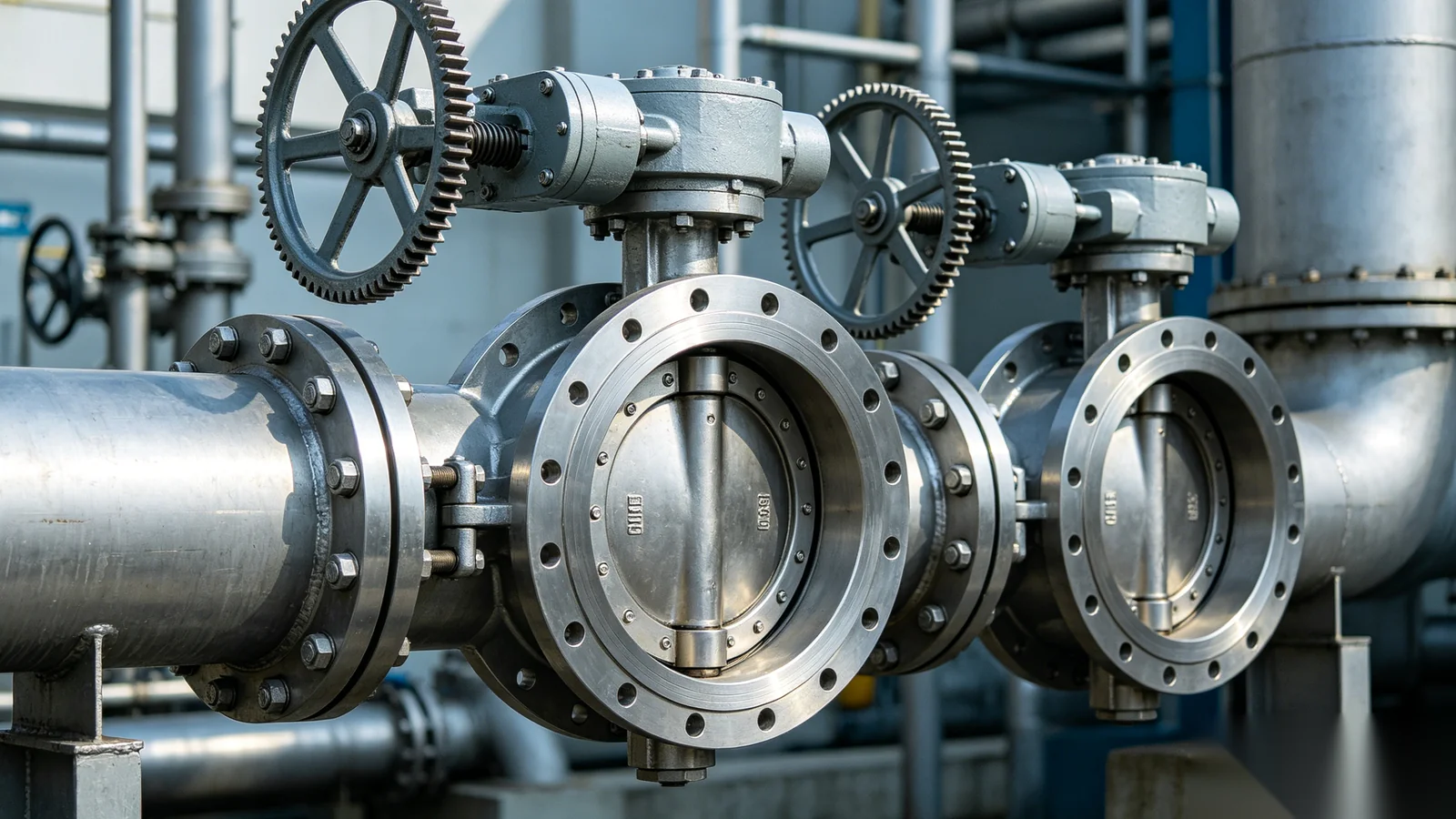
Butterfly valves dominate water, HVAC, and general process flow control with compact face-to-face dimensions and fast 90° operation. Break torque peaks when disc and seat friction are highest — especially on large rubber-lined or AWWA bodies. ValveWormGear supplies quarter-turn worm gear operators for wafer, lug, double-flange, and AWWA butterfly valves with self-locking drive, ISO 5211 interfaces, and handwheels sized on calibrated benches.
Application Foundation
A butterfly valve gear operator converts handwheel input into controlled 90° disc rotation while holding position through a self-locking worm set. Quarter-turn operation suits wafer, lug, double-flange, and AWWA bodies across municipal water, fire protection, HVAC, and process isolation. Selection starts from the valve's break-to-open torque at design pressure, then matches the ISO 5211 top flange, stem bore, and keyway.
ValveWormGear sizes each operator against the valve manufacturer's torque chart with a documented safety factor, confirms the ISO 5211 interface, and factory torque-tests every unit. Sub-type pages below cover the specific demands of wafer, lug, double-flange, and AWWA butterfly valves.
Engineering Data
| ISO 5211 Flange | Typical Valve Size Band* | Common Valve Families | Matson Models Offering This Flange |
|---|---|---|---|
| F05 | Small bore | Ball, plug, small butterfly | M07 |
| F07 | Small–medium bore | Butterfly (wafer), ball, plug | M07, M10 |
| F10 | Medium bore | Butterfly, ball, plug | M07, M10, M12 |
| F12 | Medium bore | Butterfly (lug), ball, gate top-work | M12, M14 |
| F14 | Medium–large bore | Butterfly, trunnion ball, gate | M12, M14, M14A, M15 |
| F16 | Large bore | Butterfly (double flange / AWWA), ball, gate | M14, M14A, M15, M16 |
| F25 | Heavy / large bore | Large AWWA butterfly, high-pressure ball, large gate | M16 |
*Valve size band is indicative only — actual flange depends on the valve manufacturer's top-work, stem, and torque rating. Flange options and Matson single-stage model data are from the Matson worm gearbox catalog (M07–M16, 200–4,400 N·m). Two-stage and electric-actuator series extend up to 160,000 N·m. Confirm the exact flange against your valve datasheet.
| Variant | Actuation | Typical Torque Driver | Mounting Interface |
|---|---|---|---|
| Wafer | Quarter-turn 90° | Seat friction + ΔP at BTO | ISO 5211 F07–F14 |
| Lug | Quarter-turn 90° | Seat friction; line-pressure on lugs | ISO 5211 F10–F16 |
| Double Flange | Quarter-turn 90° | High ΔP, large disc area | ISO 5211 F14–F25 |
| AWWA | Quarter-turn 90° | Large bore, buried/extension stem | ISO 5211 F16–F25 |
General selection guidance by torque demand and top-flange interface. Match the required break-to-open torque (with safety factor) and the valve top-work flange to a Matson model; exact model and dimensions are confirmed against your valve datasheet — request a datasheet.
Per-model specifications (dimensions, weights, drive bushing details): available on request — request a datasheet. Send your valve tag, bore, pressure class, and required output torque and our engineers return a model recommendation with the matching ISO 5211 interface.
Selection
Compact wafer bodies clamped between companion flanges for HVAC, fire protection, and light isolation.
Threaded lug bodies that carry line pressure for downstream removal and end-of-line service.
Reinforced double-flange bodies for higher-pressure transmission and long-span water mains.
C504/C516 waterworks valves with bury depth, stem height, and torque per utility specification.
Operation
Butterfly valve worm gear operators hold disc position without back-driving thanks to a self-locking worm and wheel — important on horizontal mains where flow forces act on the disc. Standard units ship with a sized handwheel; declutchable versions let operators switch between motor drive and manual handwheel when an electric actuator is fitted to an ISO 5211 base. Position indicators and locking devices support buried and lockout/tagout service.
Engineering
By Industry
AWWA and lined butterfly valves with IP68 options for wet wells and buried mains.
Wafer valves on chilled water, condenser, and fire-protection risers.
Cooling-water and circulating-water butterfly isolation at large bore.
Lined and lug bodies on corrosive process headers with SS316 operators.
Manufacturing Partner
Operators sized against real valve torque charts and top-work drawings — not generic catalog tables.
Standard and adapter mounting for current and legacy valve patterns without field rework.
Private label, locked BOM, and volume pricing for valve OEM and distributor programs.
STEP models, center-height tables, and export certificates issued with the commercial quote.
Common Questions
A gear-operated butterfly valve uses a worm gear operator instead of a hand lever to rotate the disc 90°. The worm set reduces operator effort, holds the disc position without back-driving, and lets one person close large valves against high differential pressure. Gear operation is standard above roughly DN200 where lever torque becomes impractical.
Common butterfly valve operators are lever (small bore), worm gear (manual quarter-turn for larger or higher-pressure valves), electric actuators, and pneumatic actuators. Worm gear operators are self-locking and ISO 5211 actuator-ready, so a manual unit can later accept an electric actuator on the same top flange without changing the valve.
A lever-operated butterfly valve is turned directly by hand and suits small bores and low torque. A gear-operated valve adds a worm gear that multiplies torque, requires many handwheel turns instead of a 90° lever swing, and holds position without creep. Gear operation is used where break torque exceeds comfortable manual lever effort.
A butterfly valve operates by rotating a central disc 90° within the pipe bore. When the disc is parallel to flow the valve is open; rotating it perpendicular blocks flow against the seat. A worm gear operator turns the stem through this 90° travel under controlled, self-locking input from a handwheel or actuator.
The ISO 5211 flange depends on the valve top-work and torque, typically F07–F14 for wafer and lug bodies and F16–F25 for large double-flange and AWWA valves. Match the valve's bolt circle, stem bore, and break-to-open torque to the operator. Send your valve datasheet and we confirm the flange and recommend an adapter if the pattern is non-standard.
Share your butterfly valve datasheet, body style, bore, and pressure class. Our engineers return a model recommendation with the matching ISO 5211 interface, torque margin, and dimensional outline within one business day.