
HVAC & Buildings
Chilled water, condenser, and fire-protection risers.
Butterfly Valve · Wafer Type
Wafer butterfly valves clamp between two companion flanges with no through-bolts of their own, giving the most compact and economical isolation in HVAC, fire protection, and light industrial lines. A worm gear operator adds controlled quarter-turn actuation and self-locking position holding once disc diameter and pressure push break torque beyond comfortable lever effort.
Application Foundation
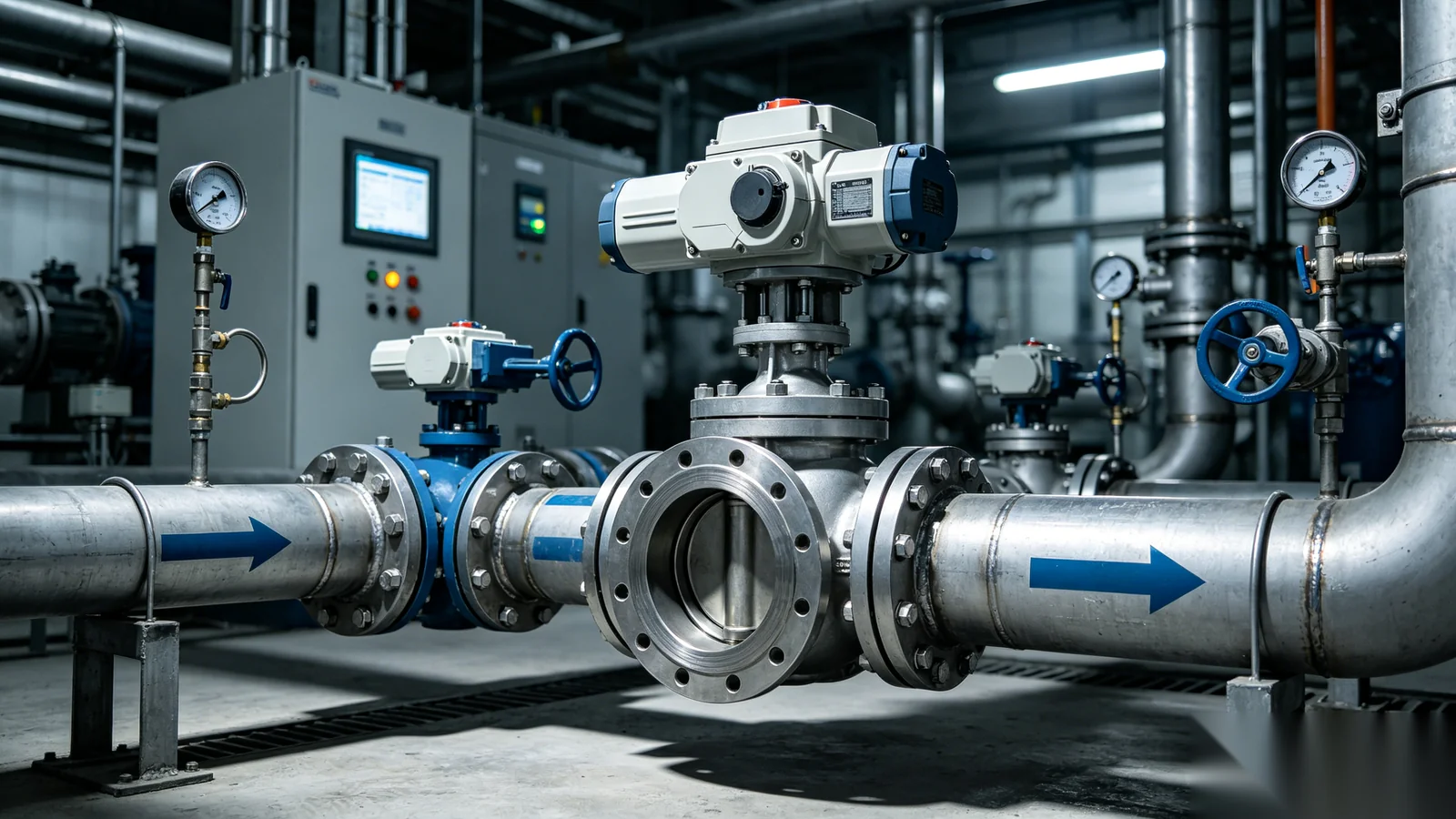
A wafer butterfly valve gear operator provides quarter-turn actuation for valves sandwiched between flanges without dedicated bolt holes. Because wafer bodies are centred by the line bolts, the operator must hold disc position reliably without adding eccentric load. Self-locking worm gearing on an ISO 5211 base meets this while keeping the assembly compact for tight HVAC and skid layouts.
Match the operator to the valve break-to-open torque at design pressure with a safety factor, then confirm the ISO 5211 top flange and stem interface. Wafer valves commonly use F07 to F14 patterns; the Matson single-stage range (M07–M14, 200–1,800 N·m) covers most wafer duties, with larger models for high-ΔP service.
Engineering Data
| ISO 5211 Flange | Typical Valve Size Band* | Common Valve Families | Matson Models Offering This Flange |
|---|---|---|---|
| F05 | Small bore | Ball, plug, small butterfly | M07 |
| F07 | Small–medium bore | Butterfly (wafer), ball, plug | M07, M10 |
| F10 | Medium bore | Butterfly, ball, plug | M07, M10, M12 |
| F12 | Medium bore | Butterfly (lug), ball, gate top-work | M12, M14 |
| F14 | Medium–large bore | Butterfly, trunnion ball, gate | M12, M14, M14A, M15 |
| F16 | Large bore | Butterfly (double flange / AWWA), ball, gate | M14, M14A, M15, M16 |
| F25 | Heavy / large bore | Large AWWA butterfly, high-pressure ball, large gate | M16 |
*Valve size band is indicative only — actual flange depends on the valve manufacturer's top-work, stem, and torque rating. Flange options and Matson single-stage model data are from the Matson worm gearbox catalog (M07–M16, 200–4,400 N·m). Two-stage and electric-actuator series extend up to 160,000 N·m. Confirm the exact flange against your valve datasheet.
| Variant | Actuation | Typical Torque Driver | Mounting Interface |
|---|---|---|---|
| Wafer body | Quarter-turn 90° | Seat friction + ΔP at break-to-open | ISO 5211 F07–F14 |
| Geared wafer | Quarter-turn (geared) | Larger bore / higher ΔP | ISO 5211 F10–F16 |
General selection guidance by torque demand and top-flange interface. Match the required break-to-open torque (with safety factor) and the valve top-work flange to a Matson model; exact model and dimensions are confirmed against your valve datasheet — request a datasheet.
Per-model specifications (dimensions, weights, drive bushing details): available on request — request a datasheet. Send your valve tag, bore, pressure class, and required output torque and our engineers return a model recommendation with the matching ISO 5211 interface.
Operation
Operating torque rises with disc diameter and differential pressure, so size from the valve datasheet, not bore alone.
Confirm the ISO 5211 flange and stem bore before ordering — wafer valves vary by manufacturer.
Add a declutchable override only if an electric actuator is planned on the same base.
Engineering
By Industry
Chilled water, condenser, and fire-protection risers.
General process and utility isolation on skids.
Smaller distribution branches and pump headers.
Pump station and main-line isolation.
Manufacturing Partner
Operators sized against real valve torque charts and top-work drawings — not generic catalog tables.
Standard and adapter mounting for current and legacy valve patterns without field rework.
Private label, locked BOM, and volume pricing for valve OEM and distributor programs.
STEP models, center-height tables, and export certificates issued with the commercial quote.
Common Questions
A gear-operated wafer butterfly valve uses a worm gear operator on a valve body clamped between two pipe flanges. The worm gear multiplies handwheel torque and holds the disc in position, replacing the hand lever once the valve is too large or the pressure too high for comfortable manual operation.
A wafer butterfly valve sits centred between two flanges using the line bolts, so the line must be depressurised to remove it. A lug butterfly valve has threaded lugs that bolt to each flange independently, allowing downstream pipe removal while the valve stays in service. Both use the same quarter-turn worm gear operators.
A butterfly valve operates by rotating a disc 90° in the pipe bore — parallel to flow when open, perpendicular when closed. A worm gear operator turns the stem through this travel under self-locking, controlled input from a handwheel or actuator.
Butterfly valve operators include hand levers for small bores, manual worm gear operators for larger quarter-turn duty, and electric or pneumatic actuators for automation. Worm gear operators are ISO 5211 actuator-ready, so a manual wafer valve can later accept an electric actuator on the same flange.
Match the operator to the valve break-to-open torque and ISO 5211 flange. Wafer valves commonly use F07–F14; the Matson single-stage range (M07–M14, 200–1,800 N·m) covers most wafer duties. Send your valve tag, bore, and pressure class for a specific recommendation.
Send your wafer valve bore, pressure class, and ISO 5211 flange. We return a compact worm gear operator recommendation with torque margin and handwheel sizing.