
Water Treatment
Large cooling-water, fire-main, and transmission gate valves.
Multi-turn · Rising Stem · ISO 5210
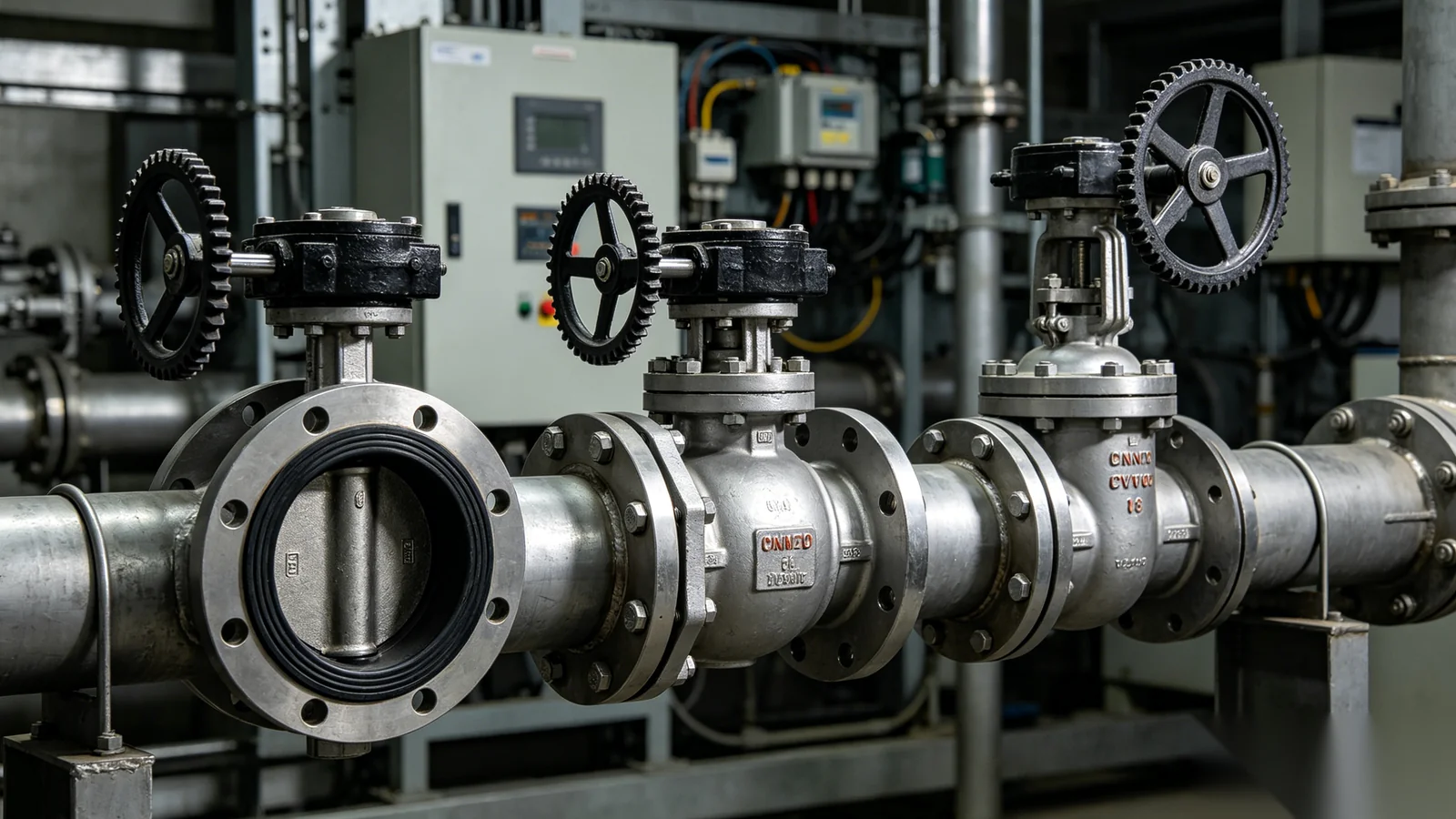
Multi-turn gear operators drive rising-stem gate and globe valves that need many revolutions to move through their travel. Unlike quarter-turn units, they carry axial stem thrust on dedicated bearings as well as torque, and mount to ISO 5210 bases. The self-locking worm holds the gate or disc at any position against line pressure.
Application Foundation
A multi-turn gear operator moves a rising or non-rising valve stem through its full travel over many handwheel revolutions — the interface required for gate and globe valves. Because the stem translates as well as rotates, the operator carries axial thrust on dedicated bearings in addition to torque, and the gear train is sized to both loads.
Multi-turn operators mount to ISO 5210 bases and use a self-locking worm to hold the gate or disc at any position against line pressure. Sizing depends on stem diameter, thread pitch, turns-to-open, and stem torque and thrust at design pressure. Per-model specifications are confirmed against the valve drawing — request a datasheet for the matched unit.
Engineering Data
| Operation Type | Valve Travel | Mounting Standard | Typical Valve Families |
|---|---|---|---|
| Quarter-turn | 90° rotation | ISO 5211 (F05–F25) | Butterfly, ball, plug |
| Multi-turn | Many revolutions, rising stem | ISO 5210 base | Gate, globe |
| Bevel (right-angle) | Per valve (90° or multi-turn) | ISO 5211 / 5210 + bevel drive | Remote / vertical-stem valves |
| Declutchable override | Manual on actuated valves | ISO 5211 / 5210 with clutch | Any actuator-fitted valve |
General selection guidance by valve travel and mounting interface; matched Matson single-stage models (M07–M16, 200–4,400 N·m on ISO 5211) and larger two-stage units are confirmed against your valve datasheet — request a datasheet.
| ISO 5211 Flange | Typical Valve Size Band* | Common Valve Families | Matson Models Offering This Flange |
|---|---|---|---|
| F05 | Small bore | Ball, plug, small butterfly | M07 |
| F07 | Small–medium bore | Butterfly (wafer), ball, plug | M07, M10 |
| F10 | Medium bore | Butterfly, ball, plug | M07, M10, M12 |
| F12 | Medium bore | Butterfly (lug), ball, gate top-work | M12, M14 |
| F14 | Medium–large bore | Butterfly, trunnion ball, gate | M12, M14, M14A, M15 |
| F16 | Large bore | Butterfly (double flange / AWWA), ball, gate | M14, M14A, M15, M16 |
| F25 | Heavy / large bore | Large AWWA butterfly, high-pressure ball, large gate | M16 |
*Valve size band is indicative only — actual flange depends on the valve manufacturer's top-work, stem, and torque rating. Flange and Matson single-stage model data are from the Matson worm gearbox catalog (M07–M16, 200–4,400 N·m). Two-stage and electric-actuator series extend up to 160,000 N·m. Confirm the exact flange against your valve datasheet.
Per-model specifications (dimensions, weights, drive-bushing details, material grades): available on request — request a datasheet. Send your valve tag, bore, pressure class, environment class, and required output torque and our engineers return a model recommendation with the matching ISO 5211 / ISO 5210 interface.
Operation
Multi-turn gear operators convert many handwheel turns into rising-stem travel while carrying the axial thrust the stem generates against the seat. Thrust bearings inside the operator take this load so it is not transmitted into the handwheel. The self-locking worm holds the gate or disc at any intermediate position, and travel limits or position indicators show open and closed states.
Bevel-gear remote drives reach gate and globe valves in pits and galleries, and an actuator-ready ISO 5210 base lets a multi-turn electric actuator replace the handwheel while retaining a manual override. Stem dimensions, pitch, and turns-to-open are confirmed against the valve drawing before manufacture so the thrust rating and gear ratio match the duty.
Engineering
By Industry
Large cooling-water, fire-main, and transmission gate valves.
Refinery and terminal transfer-line gate and globe valves.
Feedwater, condensate, and circulating-water isolation.
Penstock and bypass gate valves at large diameter.
Common Questions
Neither is universally better — they suit different valves. A quarter-turn operator drives butterfly, ball, and plug valves through a 90° rotation. A multi-turn operator drives rising-stem gate and globe valves over many revolutions and carries axial thrust. Match the operator type to the valve travel; using the wrong type causes insufficient travel or overload.
A quarter-turn actuator rotates the stem 90° for butterfly, ball, and plug valves. A multi-turn actuator turns the stem through many revolutions to raise or lower a gate or globe stem and is rated for thrust as well as torque. Multi-turn units mount to ISO 5210 bases; quarter-turn units mount to ISO 5211 flanges.
Use a multi-turn gear operator on rising-stem gate and globe valves, which need many turns to move through travel and load the operator with axial thrust. It is also chosen when a large valve's stem torque exceeds a bare handwheel's capacity. Size it to stem torque, thrust, pitch, and turns-to-open at design pressure.
A multi-turn valve gearbox uses worm-and-wheel gearing to convert many handwheel turns into rising-stem travel, with thrust bearings carrying the stem's axial load. The self-locking worm holds the valve at any position. It mounts to an ISO 5210 base and can accept a multi-turn electric actuator in place of the handwheel.
Yes. A worm gear is a speed-reduction drive: each handwheel revolution advances the worm wheel by one tooth, giving a high reduction ratio that trades input speed for output torque. In a valve operator this lets an operator generate the high stem torque a large gate or globe valve needs from a modest handwheel effort.
Send your gate or globe valve stem diameter, thread pitch, turns-to-open, and design pressure. We size a multi-turn operator with thrust-rated bearings and the correct ISO 5210 base, with per-model specifications on request.