
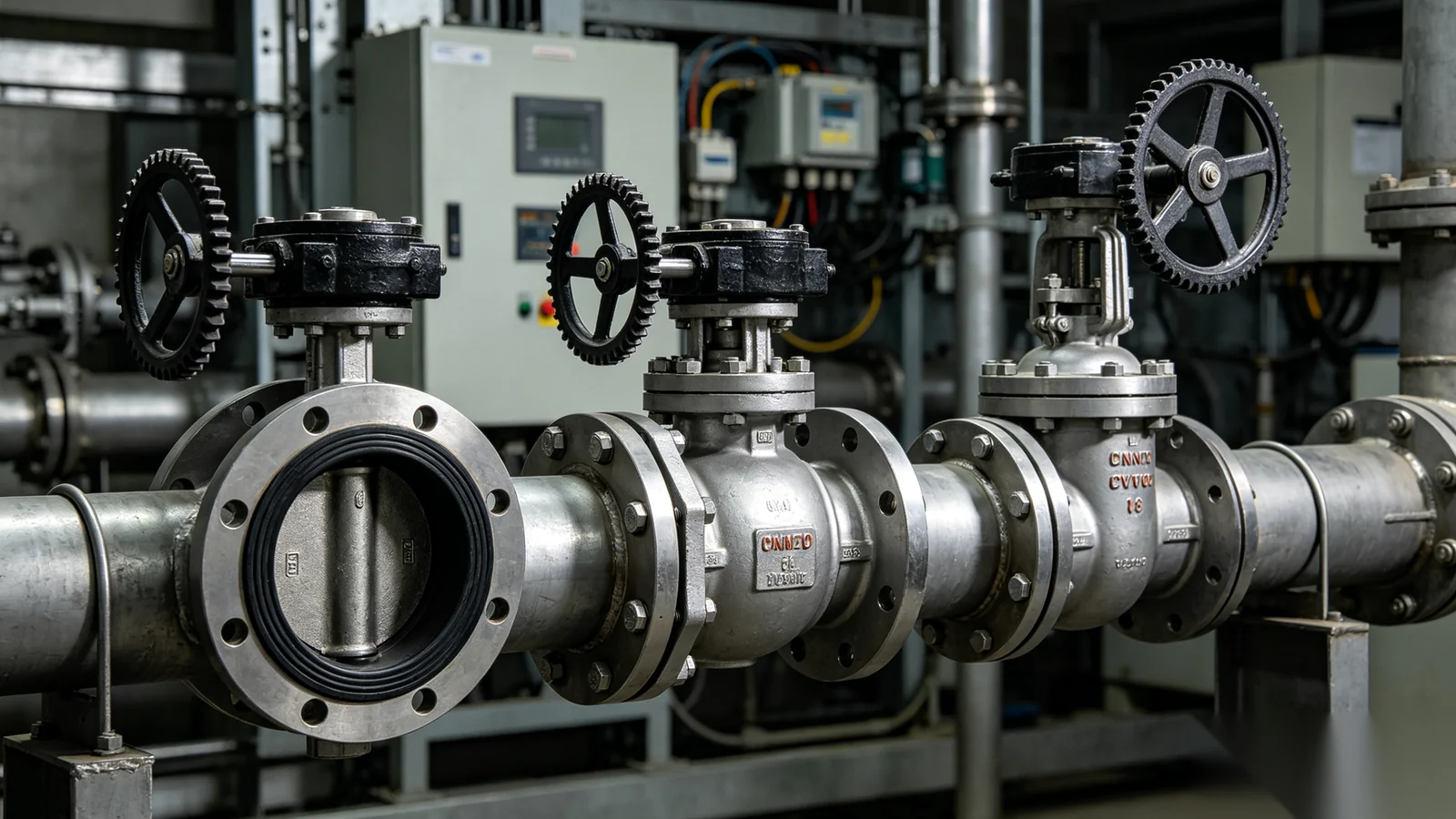
Quarter-turn Operators
90° rotation for butterfly, ball, and plug valves — worm ratios sized for seated and unseating torque peaks.
Engineering Selection · Operation Type
Select valve gear operators by how the valve moves — the single most important compatibility decision. Quarter-turn operators deliver 90° rotation for butterfly, ball, and plug valves; multi-turn operators drive rising-stem gate and globe valves; bevel gear operators redirect input for confined spaces; declutchable override blends manual and automated control. Mixing operation types causes immediate functional failure.
Fundamentals
Valve motion class determines gearbox architecture before torque or mounting is considered. The operation type must match how the valve actually moves: a quarter-turn operator cannot drive a rising-stem gate valve, and a multi-turn operator cannot rotate a butterfly disc 90 degrees. Selecting operation type first prevents an unrecoverable mismatch.
Beyond the basic motion, operation type also covers how the valve is driven and overridden: manual handwheel, declutchable manual override on a motorized unit, bevel gearing for awkward access, and fully actuator-ready topworks for automation.
Quarter-turn operation rotates the stem 90 degrees between open and closed, with peak torque at unseating. Multi-turn operation rotates the stem through many revolutions to raise or lower a gate or globe disc, accumulating stem friction and requiring thrust capacity. The two are not interchangeable.
Comparison
The comparison below maps the main operation types to valve service, motion, and key selection points.
General comparison of operation classes. Specific torque, turn count, and ratio values are confirmed per valve — no product values are implied.
Configurations
90° rotation for butterfly, ball, and plug valves — worm ratios sized for seated and unseating torque peaks.
Rising-stem gate and globe service — thrust capacity and stem nut engagement verified for full stroke.
Right-angle input for confined or buried installations — torque path redirected without losing reduction.
Rim-force ergonomics and direction of operation sized to project and local safety rules.
Motorized operation with manual declutch for isolation and maintenance, with clear mode indication.
Topworks and drive bushings coordinated with electric or pneumatic actuator interfaces.
Selection Method
Operation-type selection starts from valve motion class, then layers on drive method and environment.
Custom Support
Combined bevel-worm packages, custom override layouts, and automation integration are handled as custom engineering with CAD drawings and actuator coordination before manufacture. OEM programs harmonize operation-type families across a valve catalog.
Detailed specifications — output torque, gear ratio, ISO 5211 flange class, drive bush bore, weight, and material grades — are confirmed per project and configuration. Detailed specifications available on request — request a datasheet.
Request a DatasheetSend your valve schedule and motion requirements — quarter-turn, multi-turn, bevel, or declutchable — and our engineers confirm operation type, ratio, and automation interface for each tag. Custom override and bevel-worm configurations are released through CAD approval.
Common Questions
Quarter-turn operators rotate the valve stem 90 degrees between open and closed for butterfly, ball, and plug valves, with peak torque at unseating. Multi-turn operators drive rising-stem gate and globe valves through many revolutions, requiring thrust capacity and stem-nut engagement. They are not interchangeable — operation type must follow valve motion class first, then torque and mounting within that class.
Bevel gear operators provide a right-angle input where a vertical handwheel cannot be accessed — buried valves, tight pits, or valves mounted close to walls and structures. They redirect the torque path without sacrificing reduction capability and are commonly combined with multi-turn drives for large gate valves in confined installations.
Yes. Actuator-ready operators use ISO 5211 topworks and drive bushings sized so an electric or pneumatic actuator can be fitted now or later without changing the valve interface. Selection coordinates actuator stall torque with the operator and stem capacity and provides clearance for limit switches and control accessories.
A declutchable manual override lets a motorized valve be operated by handwheel during power loss or maintenance. A clutch mechanism switches between powered and manual modes with clear indication of which mode is engaged, while ensuring actuator stall torque remains within the operator and stem rating. It is common on automated isolation valves where manual intervention is required by specification.
Yes. OEM programs harmonize quarter-turn, multi-turn, bevel, and declutchable families across a valve catalog for consistent mounting, spares, and documentation. Combined bevel-worm packages and custom override layouts are engineered with CAD approval before serial production.