
Chemical Processing
Isolation on process and utility headers with SS316 builds.
Ball Valve · Floating
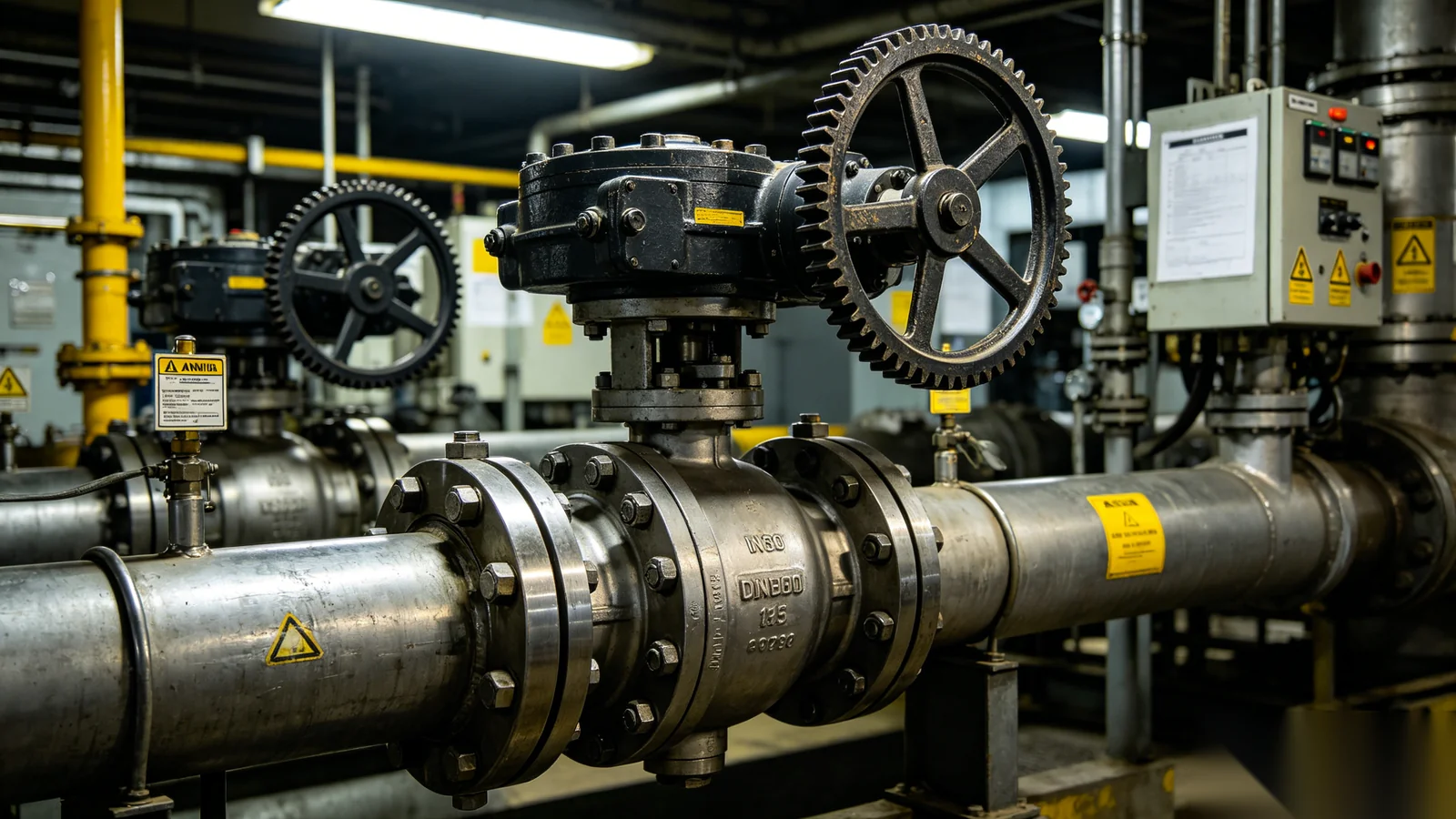
Floating ball valves seal by pushing the ball against the downstream seat under line pressure, so break-to-open torque rises directly with differential pressure and bore. Worm gear operators give these valves controlled quarter-turn actuation and self-locking hold, sized against the floating-ball torque curve for process and utility isolation.
Application Foundation
A floating ball valve gear operator provides quarter-turn actuation for valves whose ball is held only by the two seats and the stem. Line pressure pushes the ball onto the downstream seat, so seat load and break-to-open torque increase with differential pressure. The operator's self-locking worm set must overcome this peak torque and hold the ball closed without back-driving.
Size the operator from the floating-ball break-to-open torque at design pressure with a safety factor, then match the ISO 5211 flange and stem. Floating ball valves are common in smaller and medium bores; Matson single-stage models M07–M14 (200–1,800 N·m) cover most floating-ball duties, with stainless and IP67 options for outdoor and corrosive service.
Engineering Data
| ISO 5211 Flange | Typical Valve Size Band* | Common Valve Families | Matson Models Offering This Flange |
|---|---|---|---|
| F05 | Small bore | Ball, plug, small butterfly | M07 |
| F07 | Small–medium bore | Butterfly (wafer), ball, plug | M07, M10 |
| F10 | Medium bore | Butterfly, ball, plug | M07, M10, M12 |
| F12 | Medium bore | Butterfly (lug), ball, gate top-work | M12, M14 |
| F14 | Medium–large bore | Butterfly, trunnion ball, gate | M12, M14, M14A, M15 |
| F16 | Large bore | Butterfly (double flange / AWWA), ball, gate | M14, M14A, M15, M16 |
| F25 | Heavy / large bore | Large AWWA butterfly, high-pressure ball, large gate | M16 |
*Valve size band is indicative only — actual flange depends on the valve manufacturer's top-work, stem, and torque rating. Flange options and Matson single-stage model data are from the Matson worm gearbox catalog (M07–M16, 200–4,400 N·m). Two-stage and electric-actuator series extend up to 160,000 N·m. Confirm the exact flange against your valve datasheet.
| Variant | Actuation | Typical Torque Driver | Mounting Interface |
|---|---|---|---|
| Floating ball | Quarter-turn 90° | BTO rises with line pressure | ISO 5211 F05–F14 |
General selection guidance by torque demand and top-flange interface. Match the required break-to-open torque (with safety factor) and the valve top-work flange to a Matson model; exact model and dimensions are confirmed against your valve datasheet — request a datasheet.
Per-model specifications (dimensions, weights, drive bushing details): available on request — request a datasheet. Send your valve tag, bore, pressure class, and required output torque and our engineers return a model recommendation with the matching ISO 5211 interface.
Operation
Use the break-to-open torque at full differential pressure — it rises with pressure on floating designs.
Confirm the ISO 5211 flange and stem bore against the valve datasheet.
Specify SS316 and IP67 for outdoor, marine, or chemical installations.
Engineering
By Industry
Isolation on process and utility headers with SS316 builds.
Pump-station and distribution isolation.
Larger chilled-water and steam-condensate isolation.
Stainless isolation on sanitary lines.
Manufacturing Partner
Operators sized against real valve torque charts and top-work drawings — not generic catalog tables.
Standard and adapter mounting for current and legacy valve patterns without field rework.
Private label, locked BOM, and volume pricing for valve OEM and distributor programs.
STEP models, center-height tables, and export certificates issued with the commercial quote.
Common Questions
A floating ball valve seals by allowing line pressure to push the ball against the downstream seat. The ball is held only by the two seats and the stem, so seat contact and break-to-open torque increase with differential pressure. A worm gear operator turns the stem 90° and holds the ball position.
In a floating ball valve the ball is held by the seats and moves slightly under pressure to seal downstream, raising torque with pressure. In a trunnion ball valve the ball is fixed on top and bottom bearings (trunnions) so the seats are spring-loaded against the ball, giving lower, more consistent torque at higher pressures and larger bores.
A gear-operated valve uses a gearbox — typically a worm gear operator for quarter-turn valves — between the handwheel and stem. The gear multiplies operator torque and holds the valve position. Gear operation is used when direct lever or wrench torque is too high for safe manual operation.
A valve gearbox uses a worm and worm-wheel to convert many handwheel turns into a controlled 90° stem rotation while multiplying torque. The worm-and-wheel set is self-locking, so the valve holds its position without back-driving and resists creep from line pressure or vibration.
Match the operator to the floating-ball break-to-open torque at design pressure and the ISO 5211 flange. Matson models M07–M14 (200–1,800 N·m) cover most floating-ball duties. Send the valve bore, pressure class, and torque data for a specific recommendation.
Send your floating ball valve bore, pressure class, and break-to-open torque. We size a quarter-turn worm gear operator with the matching ISO 5211 interface and materials.